Friday, June 15, 2018

Fixed Income: On Singapore Savings Bonds, Hyflux Perps, PE-backed corporate bonds

In the past couple of month, there were quite a number of local news relating to the fixed income space. Have a look below:


1. MAS scraps $50k issue limit for Singapore Savings Bonds (The Straits Times on March 02, 2018)

2. Trading of Hyflux shares, perpetual securities halted (The Straits Times on May 24, 2018)

3. Investors can consider Temasek's first retail private equity bond to help supplement retirement income: Ho Ching (The Straits Times on JUN 4, 2018)


Introduction
There are 3 parts to the article today relating to the 3 articles above.

1. The burgeoning demand of the growing wealth of retail investors seeking higher yield.
2. A cautionary tale that sometimes all that glitters may not be gold
3. The "right" way to introduce a new product to the retail market


First, it was often thought of as unusual that Singapore, a first world country with one of the highest GDP per capita in the world does not have a thriving retail bond market.

- Most bonds are only opened to sophisticated institutional investors
- Minimum size of $250,000 per bond
- Lacking liquidity (hypothetically given the size of each bond)....this likely also contributes to a wider Bid-Ask spread


Part 1 - SSB
When the SSB was introduced in July 2015, I took part in it as it was a great way to take part in a new instrument backed by the Singapore Government.
1. Better rates than bank deposits
2. Flexible in terms of exit ($2 admin fee only)
3. An interest rate effectively anything from 1 year - 10 year bond depending on when you exit
4. Another advantage is that as it is not traded, you do not risk any capital losses should you need to exit early. The trade-off is that you do not get capital gains should the general interest rates fall.

Recent news of the removal of $50k application limit simply just tells that while you can apply for more....it doesn't mean you can get more (allocation limits still apply)....which really points back to the original question of why a $50k application cap was there to begin with - probably more of an administrative issue.

Conclusion: SSB remains a great tool for income building as an area for rainy day fund. The rising interest rates also allow Singaporeans to get better returns on their buck in time to come. The $100k ceiling also ensures that this remains open to the man on the street.


Part 2 - Hyflux 6% Perps

Subscribing to Hyflux latest 6% Perps felt like a good deal in 2016. I too took part in that event being fully cognizant of the risks. For one, 6% return was a really good payout and utilities (power and water) being a very center piece of Singapore security would mean that it is unlikely that it would be allowed to fail.

How wrong everyone was on that assumption...

In 2018, Feb - I begun to be quite concerned about the falling price of both Hyflux (mainboard shares) and the price of the perps. It was the facts that stood out
1. Chronic inability to generate cashflow
2. Current ratio falling alarmingly low (as of 1Q2018 - a simple look would have seen it as 1.46 but actually it was more likely closer to 0.41 given that an "asset for sale" was parked under the current assets listing)
3. Loss-making huge asset (Tuas Spring)

I asked myself in my quarterly/annual review....if I had to sell everything and buy them back. Which would I buy?

Would I buy a company that was losing money? Would I buy a company with huge debt burdens that could not be serviced within a year? Would I buy companies with high capex yet the cashflow cannot meet the working capital needs?

I begun to saw similar trends in the power business. Olivia Lum (Hyflux CEO) herself stated that a bunch of them (utilities operator) wrote to the government and "complained" about the glut in the business environment - that it was not sustainable.

Certainly not music to my ears!

I exited Hyflux at about 17% losses after taking into account 2 semi-annual payouts that I received.

Certainly a painful decision! However, not as painful as what was to come in the next 6 months.....

When the notice of delay in redemption and payouts of the perps became news on the straits times...it became increasingly clear that the cash pile had run dry.

How will Hyflux work this out? I certainly do not know....it is quite possible that there are several options out there:

1. Declare the equivalent of "chapter 11" bankruptcy
- This would result in an appointment of a Judicial Management that will manage and sell the assets of the companies to pay back the debt.

2. Infusion of new capital (White knights to the rescue)
- Unless there's a good viable business that remains...or a new strategy out of this issue...it can be hard to convince new (or even existing) investors to put money in there as it may tantamount to throwing "good money" after bad.
- Other questions also remain whether this business is "cyclical".....I think utilities are anything but cyclical...it tends to be more stable with the exception of cost of production (e.g. crude oil prices).

3. Exchange of debt for equity deal
- Existing debts (banks, bonds, perps) will have to be exchanged for equity in addition to new credit lines for the company....this scenario was common in the recent offshore crisis where many smaller O&M companies like MarcoPolo Marine, Ezion made deals to manage their cashflows through the downcycle.

I am thankful for getting out of this with my hat. Looking back, I think it was a very risky investment with high idiosyncratic risk. Current debt holders face a big headache and a very lengthy journey in getting back a portion of their money (my guess is probably somewhere between $0.15-$0.30 on the dollar if they are lucky)

Imagine the losses - at last traded 0.50. I would have lost 44% of my capital and possibly up to 79% of my capital in the worse case ($0.15 on the dollar estimate).

Conclusion: If something doesn't look right, it is best to exit quickly and decisively. There are tell-tale signs and we can always pay more attention to these first signals.


Part 3 - Astrea IV Class A-1 Retail Bond (4.35% p.a - semi annual payout)

After a big debacle with Hyflux, you would wonder who would be interested in bonds. Hyflux turned out to be a high risk, low return proposition that burnt many fingers. Imagine that original $500m of perps issued....nearly half of it has been wiped out to-date!

Enter a new product which has links to Temasek. The first ever retail bond funded by the cashflows of the 36 PE funds that the money is invested in.

I found this interesting as well as exciting that Ho Ching (CEO of Temasek) actually introduced it in a very similar way to how they introduced the first ever S-Reit Capitaland Mall Trust (CMT). In some way - the "democratization", introduction and allowing the retail investor to have some share in this new asset class excited the investment community (myself included).

To cut the long story short. I invested in the bond and was delighted to have received 4 lots.

Here are some key reasons why I placed my money there:

1. You make some money buying it on day 1 because some "money was left on the table"

4.35% p.a. semi-annual payment (this compares to the average 3.1% for a similarly A-rated 5 year corporate bond). Based on my calculations - the bond is worth $1057.08 on first day of trading so it is really a return of 5.71% just by buying it on day zero.

It also has step up 1% from the 6th - 10th year if it is not called in the 5th....this effectively makes it a 4.85% bond if you hold it for 10 years. This compares very favorably to the average A-rated 10 year corporate bond at 3.65%). Based on my calculations - the bond is worth $1099.05 on first day of trading so a return of 9.9% just by buying it on day zero.

Conclusion 1: Immediate returns of 5.71% - 9.9% does sound good to me.

2. 5 Structural safeguards in place

a) Reserves Accounts - cash build up over time will be used to repay the principal of the class A-1 and A-2 bond. (Basically means it will definitely be redeemed if there are sufficient money available)

b) Sponsor Sharing - after payment of performance fees, expenses  are met, 50% of remaining cashflows are allocated to the reserves account. This allows for faster build up of reserves for the 5th year call redemption timeline

c) Maximum LTV ratio of 50% ensures that there is a need to pay the reserves account and redeem Class B bonds until the maximum ratio is no longer exceeded. In this scenario, should the value of the portfolio falls - the sponsors will have to maintain a prudent ship by managing the debt ratios through redeeming bonds.

d) Liquidity Facility allows the issuer to drawdown from the bank to pay senior payments, expenses and interest payments of the Bonds if there are insufficient cash. This is up to USD100m

e) Capital Call Facility, similar to the liquidity facility allows a drawdown from the banks to pay capital calls.

Conclusion 2: Plenty of protection for the retail investor (although probably not everyone understands how they work - I haven't heard of some before)

3. Understanding the tranching of the CDO in the risk/return context

If you recall the 07-08 financial crisis. The nature of the CDOs were rated as top grade, some even argued that this was not wrong as there were good mortgage debt in the top most tranche but these were also mixed with bad debt from NINJA (people w mortgage loans but no income, no jobs)....given the risk drivers was only housing prices rising...it became a very dangerous bubble then.

In this case, we refer to the below picture of being in the A-1 & A-2 top tranche.

The most important picture

Given the risk/return quantum, it would appear that we have a defensive cushion of at least 65% (USD713.96m) made up of Equity and Class B before it would impact our portfolio.

Conclusion 3: The risks are indeed low and we should sleep well knowing that it would take quite a few of that 36 portfolios to go under collectively before it would impact the Class A group (this is what we get for getting a fixed payment while the equity could have many folds on their return)


Possible risks
1. Liquidity risk - Well highlighted by DBS Bank head of fixed income, Clifford Lee accurately stated that this instrument is new and "it may take some time for a secondary market in PE-backed bonds to develop". This actually means you may have trouble in finding liquidity for this bond should you need to sell and get back your cash

2. Interest Rate Risk - Over the next few years, interest rate is expected to rise. The element of interest rate risk cannot be discounted if you need to exit prior to the 5 year / 10 year redemption mark. As interest rate rises, your bond would fall in price. Interest rate acts as gravity on asset prices and it would affect pretty much ALL asset classes (unless the asset has a floating rate element that helps you to capture the upside)

3. Default risk - Expected to be low as the funds are managed by relatively big PE players as well as generally mature profile (7 years since vintage)....these funds are expected to be cash generative as the deals are exit.


Overall conclusion: Buy and hold as we will expect it to be redeemed in 5 years. It is after all one of the A grade bonds that have first surfaced under the Temasek branding and we look forward to more of such issues for the man on the street.


Friday, February 2, 2018

Divesting when the case no longer holds (special situation concluded)

On Monday, I woke up to a news on Bloomberg flashing news about the Singh brothers of Fortis Healthcare, the sponsor of RHT Healthtrust. 

https://www.bloomberg.com/news/articles/2018-01-28/billionaire-singh-brothers-accused-in-lawsuit-of-siphoning-money

Long story short, the news was bad for the case of special situation (at least the position I was taking). In addition to the earlier case of Japanese investor (Daiichi Sankyo) suing Singh brothers for the fraud. This was an additional nail to the coffin which would prevent divestment of any of their personal assets (i.e Fortis or Religare shareholding) to raise funds for the RHT assets buyout. 

I quickly sold my stake that morning. The basis was that while the Japanese investor could have their case overturned, American investors being involved added a whole new conundrum to the game. This was a measured probability that the acquisition funds was very unlikely to be found in the next 1 year time frame.


The red flags

It didn't take a genius to figure out other red flags in this deal:

A. Delayed payments of leasing fees by Fortis Healthcare

B. Double lawsuits that potentially block any capital raising required for the acquisition by independent parties (First the Japanese, followed by the Americans)

C. The case of fraud and question of character


Everything begun collapsing pretty quick

1. Around Mid Jan - RHT Healthtrust reported to the regulators that the delayed payments would be given as of 31st January.....sounds positive? It turned out only 1/3 of the payment was received. If someone could barely find money to pay his water bill, would you trust his agreement to buy your house?

2. The Ranbaxy deal was touted as "Dirty Medicine" by Fortune Magazine. I leave you to go and figure out what that means. In any case, with the impending lawsuit ongoing, courts tend to stick to the earlier judgments. As I learned in law school, if judges overturned each other cases like a pancake machine - the country would be pretty chaotic.

Turns out that yesterday, news broke the Delhi court upheld the case "Malvinder Singh and Shivinder Singh must pay Daiichi Sankyo Co. 35 billion rupees ($550 million) awarded in an arbitration over the sale of a drugmaker controlled by the brothers, an Indian court ruled."

More cash problems? Still think he can pay for your house?

3. Lastly if someone tells you somebody can't be trusted. You may say hmm, this two may have disagreements and bad blood, I should reserve my judgement till I meet him myself. If a couple of days later, someone from far away, tells you this chap can't be trusted - I think it begins to form a pretty complete picture of what he is.

Like Warren Buffett said - I look for 3 things in an individual, Talent, Energy and Integrity. Unfortunately, if he does not have the 3rd one, let's not even discuss the first two.


As of today. RHT price trades at 3.63% below my sale price. I may be right, I may be wrong - but nothing beats a peace of mind. Best to move on.

Wednesday, December 27, 2017

What the analysts been saying recently

Recently I did a compilation of analysts targets (total of 7 research houses) - these information were extracted from "sginvestors.io"

Here are some observations:
1. Large cap companies tend to have a bigger following - so theoretically they should be better priced (i.e. not too far from fair value)

2. On considering whether to add dividend yield to these average prices, I realized that would be double counting. The analysts have already imputed those information into their calculations so it would not be right to add it in.

3. Average targets and the subsequent upside would not be complete without a calculation of the dispersion of analyst targets....interestingly DBS had the biggest dispersion while some smaller companies like Guocoland have analysts agreeing pretty much with each other on the fair value.

Here's the list of data with a little comments from TFG. Enjoy and happy analyzing.

On Blue Chips (STI):
- ST Engineering, Thaibev & Singtel look like safe bets for the year with the least dispersion and higher target prices


On Reits:
- Reits look fairly valued and may see only single digit gains (inclusive of dividends) for 2018.


On Small caps:
- The kind of stocks that give you the big boost over the next few years. Small companies with lower analyst coverage but with strong moats and significant growth story could be the right play for years to come.


Cheers.

Thursday, December 21, 2017

Special situations - is it a gamble or a subset of what we already know? (The case of RHT Healthtrust)

Today's topic is about Special Situation investing.

For the uninitiated, Special Situations refer to any of the below scenarios:

1. Merger & Acquisition
2. Asset Sales & Purchase
3. Recapitalization and turnaround

etc.

If you know what you are doing. Sometimes a very complicated deal may make sense. But if you don't know what you are doing, there is no shame in admitting it. Only when people pretend they are experts, then its a real shame - plonking money in something you don't understand is really gambling.

Personally in the field of special situations - I admit, I have much to learn and have bought Joel Greenblatt book "You can be a stock market genius" - apparently the best selling primer on such deals which I come to love and appreciate.

Now on to the case:

Recently I did a simple analysis for RHT Healthtrust. A quick introduction as below:

RHT healthtrust owns healthcare assets in India. Leasing the asset to its parent company Fortis. As of 14th Nov, Fortis decided they have a change of heart (strategy) and wanted to go asset heavy once more.

This news caused the share price to surge 15% on the news. People were a little murky on the details and couldn't figure out the price with debt, without debt repayment etc.

I had half a mind to jump in immediately, but some quiet meditation and thoughtful thinking later, I decided to let the dust settle first before looking at the deal.

As of couple of days back, the price fell within a sweet spot. Which I call the low risk high return quantum of minimum 3x upside compared to the downside.

How did I derive upside price? Here's my 3 part analysis

Part 1: Figuring out what the deal is worth


Given that the deal is valued about 46.5 bln rupees. And paying off the debt, the offer values the company around the range of 765m SGD. This would give an offer price about $0.94. Adding some accrued dividends, we should get a final price of $0.97. The deal takes a big chunk and matters most, therefore a 50% weight is a minimum.

Part 2: Taking into account what the analysts think


Taking a simple average of 4 analysts - we get an average of $0.8875. Given they are experts, I give them a 30% weight.

Part 3: Some basic due diligence (Relative Valuation)


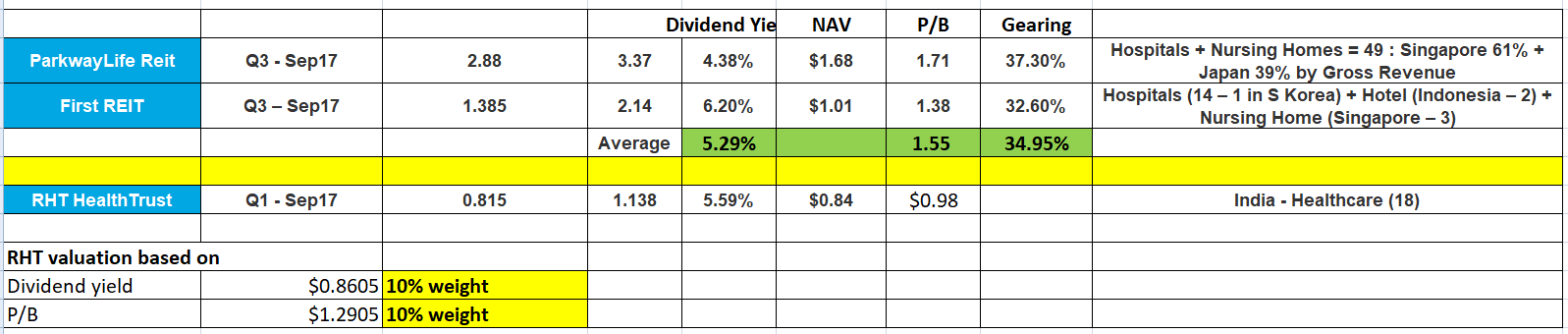
Using the only peers available on the SGX, Parkway life and First Reit. You get two very different players but in similar business of leasing out healthcare assets. Using dividend yield, P/B we come up with two values.
Dividend Yield gives about $0.8605. P/B gives a value of $1.2905. By the PB ratio basis, this deal is really undervaluing the potential of the company, dividend wise - about the normal.
I gave both valuations 10% weight each.

Assumptions:
1. FX (INR-SGD) remains constant
2. Company does a payout of cash and dividend
3. Deal goes through with no competing buyers (this is actually positive on the upside but affects the deal timeline)
4. Company pays down debt, pays out cash and winds up the business

Downside
Quantitative risk
1. Blockage/Deal does not go through - company worth intrinsic value of 0.84
2. Lowest closing price of 0.795 and lowest 52 week price 0.71
Price Average 0.782
Downside risk -4.09%

Qualitative risks
1. Depreciation of INR
2. Other possible risk such as Fortis going belly up/unable to raise capital are minimal given standard chartered's commitment to a 50bln rupees capital raising event
3. Parent has yet to pay relevant fees for half year (potential query as to its cashflow issue)

Announcement                      15-Nov
Time frame                            60 days
Expected conclusion             14-Jan
Remaining days                     33 (as of 15 Dec)
Weighted price expectation  $0.971
Purchase Price                      15-Dec @ 0.82
Expected returns                  18.42%

Annualized return                203.76%

Final conclusion: Buy by sizing (no more than 10% of portfolio due to country risk) 4.5x upside vs downside.

Disclosure: Author has a small sizable position of 5% of his portfolio in the deal.

Sunday, September 3, 2017

Stalwarts of the 90s and the end of moats

Listed on the SGX, many of the below companies have grown over the years from strength to strength. Today's article covers the problems they face in the face of disruption.

1. Singapore Press Holdings
2. Singapore Post
3. Singtel
4. Comfortdelgro

5. Keppel Corporation
6. Noble

7. Singapore Pools (not listed, but just here to illustrate a point)
8. Singapore Technology Engineering
9. SATs
10. Singapore Exchange

How the mighty has fallen in the era of disruption

As technology and new business models threaten industries. Many billion dollar companies have been hit by the smaller players who grew up and have big ambition/plenty of money.

Think media - SPH. A company with brand and substance to back and yet they are failing. Why?
This probably lies in the complacent nature of management and its inability to disrupt the status quo. We could see new media/social media appear. I mean if you had ambition, you would grow business times/share investor to become something like Fortune, Baron's, Financial Times - basically international news. And only now they started shifting their strategy.....to areas of healthcare, property, education. Well good luck, if that is not 'diworsification', I don't know what is.

Think delivery - Singapore Post. Hit by itself really. In an era where they are still a monopoly, they failed to grow any secondary industry....even now while no one is really disrupting the delivery business but they have horrible service and an inability to grow inorganically. Their bad acquisitions just show a poor level of management capabilities to handle the new era. I think even Alibaba isn't betting on this horse as it acquired Lazada and Redmart to play in the region.

Think telecom - Singtel. Singtel is a smart company. As a true blue chip, it has grown its presence all over Asia - in India, Australia and around. While telecoms remain an expensive business with high capital expenditure costs. It is unlikely to be disrupted to the same extent as the basic understanding is that communication is a basic, provision of broadband is a necessity and well entertainment (cable tv) is part of life. Does anyone watch TV these days though?
On a side note TPG is threatening to eat into its Australia and Singapore business....can a business truly under-price everyone else to take out a market leader? I wonder.

Think transportation - Comfortdelgro. While probably no one is disrupting the infrastructure of train and buses. People are disrupting the transport business with the model of shared economy. These days, private cars have taken to the roads and provide the very service of transportation. Grab, Uber has transform the industry and are beginning to take on the delivery business of food as well. Can they vertically change the industry? Only time will tell if their cash burn can grow their presence to a sustainable size. Comfort on the other hand has seen its number of taxis being rented declined to the extent that it has reached out to uber for further collaboration.

---------------------------------
Cyclical business

The second group of companies I want to cover are those with exposure to commodities.
Namely Keppel Corp (to oil) and Noble (to hard and soft commodities).

Keppel's position as no.1 O&M offshore rig was really admired 5 years ago. To think that we were reading about how the battle for Brazilian oil rig deal was the big big thing. Fast forward today, allegations about corruption/bribery/govt espionage. Man. That's really not a pretty sight when the music stops. Will Keppel survive? I certain believe so, the company has some of the brightest talents and their strength allows them to grow their fund management business, property development, infrastructure and different parts of O&M (e.g. LPG). O&M is cyclical and well....it remains to be said but I don't believe their moat has been destroyed, just cyclically under performing for now.

Noble on the other hand, is on the highway like a lemmings off the cliff. Many years of high debt has finally caught up to it as shortsellers circled it like a shark. The company in desperation to stay afloat sold all its crown jewels. What is left is a couple of junk trading business that is resulting in all the key management leaving. If the captain of a ship (CEO and Chairman) is taking the life boat out, I advise that you don't stay on as well.

------------------------------------

Business with strong moats

Singapore Pools. Undisputed money churning company of providing hope. Even two casinos could not take away the regular habit/hobbies of people just punting and hoping for a brighter future with winnings (hopefully millions). Online gambling is illegal in Singapore and well, people don't trust digital money so much as it may just be an online theft.

ST Engineering. With a business with the SAF. How could you possibly go wrong. As the only AAA rated listed company in the fixed income market in Singapore. ST Engineering has the orderbook and dividend that pays. Early shareholders know the testament and enduring nature of the defense industry and as long as Singapore govt continues to dedicate 5% of its GDP to defense, we are going to continue to see the company roll on.

SATS. A company closely intertwined with Singapore's aviation industry. As Singapore remains an Aviation hub for the region. SATS has a strong plan of providing food and ancillary services to the aviation industry such as logistics and handling services. Till the day people are able to travel quick and safely via another mode of transport other than flight or Singapore loses its Aviation hub status. SATS will be here to stay as it rides on Singapore new air terminals opening.

SGX. Trading stocks, bonds, derivatives and listing companies is a bread and butter business. Will this industry ever disappear. Very unlikely so. While the digital era has enabled bond raising through private means (such as crowdfunding and IOUs). The size and segment that SGX caters to are still big fund managers and nobody really could replace exchanges in such a market.


What should you invest in then?
1. Look for companies with a strong moat (competitive advantage) - e.g. the 3rd group / Avoid companies without it!
2. Look for those with great managers and strong corporate cultures of putting the customer and employee first before shareholders
3. Figure out a fair price to pay, and wait for that day to come. Buy when its on sale.
4. Review yearly by going through step 1-3.

Friday, August 4, 2017

Behavioral bias, laziness and the arrival of an eCommerce titan

When I was a university student, we published the results of our project that covered the behavioral bias of human nature - in particular related to investment decisions.

Today, I address 3 key thoughts about the week:

1. Home Bias & the problem of investing in your own backyard
I was watching at a google talk by Meb Faber recently. And it appears that the problem with most investors is that they focus a lot on just investing in their home markets creating a concentration risk that affects the upside of the wealth accumulation process. Feel free to catch the story below as he talks about CAPE (Shiller 10 year ratios) as well as the problem of home bias.
Mebane Faber: "Global Value: How to Spot Bubbles, Avoid Market Crashes, and Earn Big Returns"

Lesson: The opportunity sets are larger overseas and it may be good to look outside your country.

2. Problem of coat-tail investing & the problem of laziness
People that invests on hot tips, following fund managers, bloggers, insiders etc.
The problem with this is that it creates a culture of laziness - and I find myself guilty of these in recent times when I have less time. The damaging effect of thinking that others have done the homework and that we can just hop on board rather than taking the effort to think and rationalize each decision...

Think about what happened with Noble Group (negative cashflow), Sabana Reit (bad interest rates and declining DPU) and the likes of it....if we do not take the effort to do our homework...we are really setting up ourselves up for trouble - if you just buy a stock because a famous investor is onboard, you wouldn't have appreciated the process of reaching that outcome, this would make you a speculator and you would be the first to flee when the price starts falling.

Lesson: Be objective, think it through. Don't let the price or the investors affect your need to do due diligence and make good judgement about a business.

3. The rise of e-commerce and the inability of companies to adapt
Amazon Prime is here - and certainly the ultimate challenger is here to take on all our incumbents. Think retail malls, f&b, Singpost etc etc.

Companies that would survive this onslaught may be the ones that build a strong brand loyalty, and how companies do that will have been through building up great customer experiences. I strongly believe that capitaland's strategy of managing retail malls is the best-in-class and they are probably onset to replicate this to cover a large part of China.

On the flipside - companies like Singpost may be in trouble. Notwithstanding bad acquisitions with failure of corporate governance, Singpost appears to be the milking of an old cow - as mail service drops, they attempted to acquire TradeGlobal which resulted in a massive writeoff in the tune of about 180m. Tails of insider transactions and you wonder why nobody is punished as yet.

Recently I also tried to purchase something from Amazon through vPost. Long story short, vPost provides really bad customer service and incomplete instructions when you are shipping items that do not compile with their 5000 pg articles.

Lesson: eCommerce is here to stay. But to invest in this industry, you need to be aware of how the companies adapt and create an enduring experience for their customers to keep coming back - easy to say, hard to execute. On a sidenote, dear vPost- I probably will never buy from you again. Bad financials, bad management and horrible customer experience - it is now increasing clear why Alibaba prefers to build a logistics arm in Malaysia rather than ride on Singpost one. Jack Ma to launch Alibaba's regional distribution hub in Malaysia: sources

Saturday, June 17, 2017

2017 looking like a decent year to most investors (or is it?)

2017 has look a lot brighter for me personally. It feels like sunshine is thawing a long cold winter.

On the investment front, some of my recent picks this year have done well....even the bad picks of last year are looking brighter.

Top 3 picks:
Venture Corp  + 23.64%
Capitaland      + 15.41%
CWT Ltd         + 13.37%

As a portfolio manager, nobody knows our needs better than us. If we don't take responsibility and exercise discipline, we could find ourselves in a lot more trouble when the tough times hit. This is when I often think about the past and know that given the game is so hard - it is best to avoid the losers. 

After all, even Warren Buffett's two rules underline the fundamental that as long as you don't lose money - it is a great sunny day. You live to fight on.

-------------------------------------------

As a relatively young working adult, I believe it helps to reflect on things often and while being young means time is on your side - It always pays to be humble, and continue to learn. The most pertinent warning comes from this 2007 TNP article I chanced upon recently.

BURNT BY STOCKS - I LOST $700,000 IN 3 MONTHS
Student on winning stock market streak, then he loses dad's life savings

Lesson points:

1. Money doesn't come "easy"
If you think money is easy to be made, you may be sorely wrong - people may be right for the wrong reasons and wrong for the right reasons. The game is never in your control - the day you think you are 'master of the universe'  - that's a very dangerous day

2. Never borrow money to invest
Markets can stay irrational longer than you stay liquid. If you do not have the holding power, you cannot ride out a storm.

3. It is an emotional game
Mastering control over fear and greed is necessary to do well. Otherwise just stick to regular investment in index funds.

-------------------------------------------

With this lessons in mind, I am cognizant that some rethinking and rationalizing of my portfolio is necessary.

My strategy
1. Reassess the worse case scenario (maximum downside that any asset could have) 
    + This is defined as the point where you will bet the house (but someone else's blood is on the 
        street)

2. Managing the cash/bond portion of the portfolio (having a larger portion in this segment will reduce volatility) 
    + The goal is target quarterly re-balancing to 60-20-20 (Equity-Bond-Cash)

3. Take some profits off the table to manage risk (Rome wasn't build in a day and neither is personal wealth)
    + Bird in hand is worth two in a bush. My father often told me profit is (paper profit - unrealized)   
       but losses are actual losses as it may never 'come back'.

All the best.